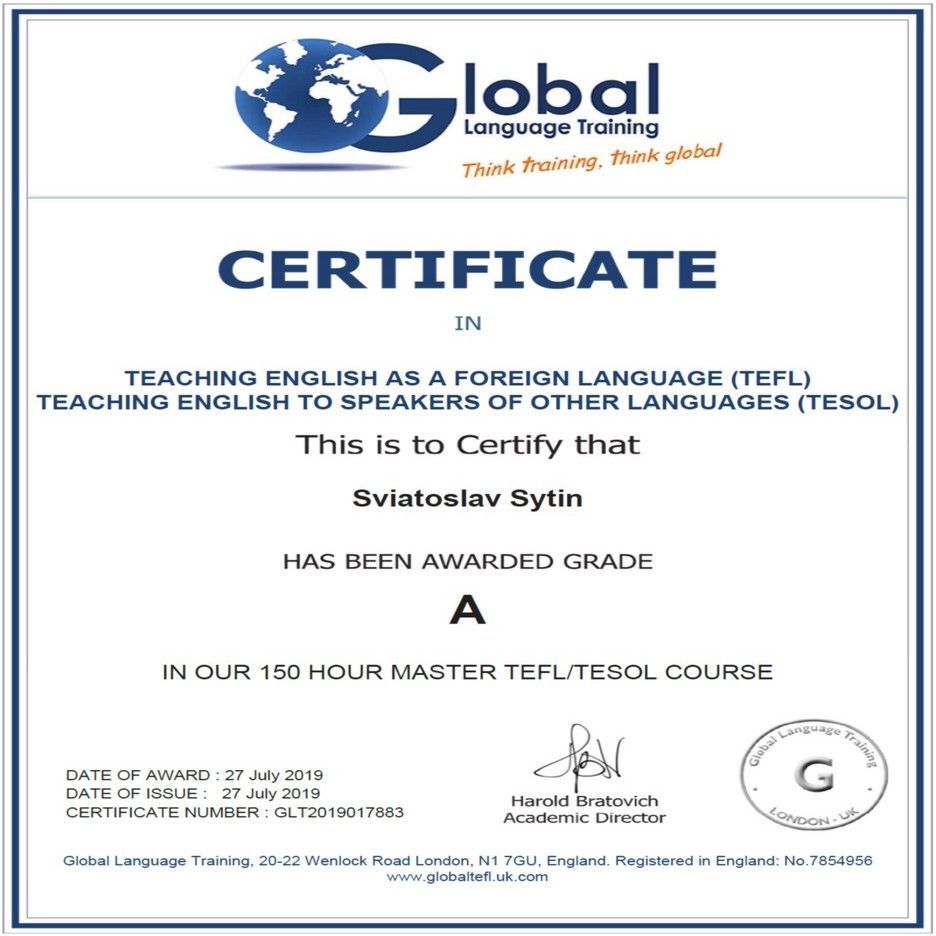
=obtained qualifications & worked-out requirements - through the TEFL/TESOL module content narration=1/Grammar: researches to improve teaching knowledge & techniques/associated challenges & quiz assessment activity/context communication through L2 syntax & vocabulary/key grammar activation in the lesson plan or the textbook units & checking of comprehension (how-to).
2/TEFL (for foreigners) & TESL (for bilinguals): group-learners by ages & tasks management/YL & teens vs. adult approaches/communicative principles of teaching.
3/Communicative teaching principles: role of grammar in CLT & learner’s error/accurate & fluent speech approaches/error identifying & correction methods/basic types of skills to teach/role motivation & interchanged group work (task delegation models)/interaction patterns’ challenges & motivation activity in the class/roles of a learner & the teacher by varied domination in the context skill & errors detection/key CLT activities types & the lesson analysis.
4/Lesson planning & adapting materials: choice of a warm-up section by age-level groups/types of activities & applied principles by the lesson objectives/key object introduction stage in repetitive context/guided discovery presentation & concept-checking questions/structured activity practice vs. fluency practice stage/building up a balanced lesson (how-to)/PPP (as presentation-practice-production) lesson plan vs. TBL (as task-based-learning) concept approaches.
5/Teaching the speaking skill: enhanced emphatic drama or stage received pronunciation & standard speaking strategies/conversation & narration vs. functional specific speech guidance/role of the teacher as a monitoring participant & a learner’s confidence throughout the errors/vocabulary extension in controlled speech accuracy vs. fluency enforcement presentations/(how-to) phonetic enhanced emphatic articulation activities on an audio-script for the context phrase intonation perfection/(how-to) role-play management through drama discovery in the ESL class (accuracy vs. fluency).
6/Teaching the listening skill: applied interactive technology sources & genuine information supply into the class content/extensive & intensive listening tasks/(pre-while-post)-listening activity in a lesson plan/role of the teacher as a cooperative listener & prepared roles or delegated responsibilities on the post-listening feedback analysis conversation/music & video rhythmic content for the specific YL audience/documentary or drama video content in the adult groups.
7/Reading skill & vocabulary challenges: extensive & intensive manners of sub-cultural contextual immersion/skimming & scanning purposes of a text discovery/vocabulary performance & a role of the teacher in a context research/presenting & checking for meaning of new words & collocations in the current vocabulary.
8/Writing skill & error correction: gist evaluation & assessment on the comprehension or reasoning/L2 & L1 writers’ difference in the style of genuine narration/focused monitoring points on the story structure (plot-detail-opinion-conclusion-abstract)/genre identity approach in teaching writing/building up the writing habit & a role of the teacher in the confidence motivation through genres/prompts’ manner & organizing process of the narrative skill development for a targeted aim/corrections & assessment management principles & process/colloquial style errors & correction workout approach.
9/Classroom management in a real-time lesson: prepared & communicative behavior of the teacher on a lesson objectives/expectations on a learners’ behavior & its support/clear & targeted instructions (TTT)/discipline issues maintenance through age groups (YL/teens/adults)/expected problems in discipline & its delicacy or motivational handling/large class instructions & conformity guidance strategies.
10/Teaching specific (academic EAP/business ESP) groups: special vs. General academic purposes language & content/follow-up analysis of genuine or abridged educational resources/personalized thematic lessons & business industry English activities (in the targeted theme)/YL introductory immersion strategies & lesson planning/kids in-class gaming motivation patterns/CLIL approach on a subject (as the content-and-language-integrated-learning) on the associated disciplines & industry themes.
11/Lesson planning format & approach: grammar performance objectives & targeted academic instructions/skill-targeted development of a lesson plan in the content objectives/student vs. teacher talk time in separate parts of a lesson scenario.